Tuesday, 12 March 2024

Kerry Dilks

Kerry Dilks has enjoyed doing art since childhood. She was born in Ilkeston, Derbyshire, and has always lived in a large, ex-mining town, sitting at an equal distance between Derby and Nottingham in the East Midlands.

She is passionate about children's picture book illustration. "From the moment I could hold a crayon, I wanted to communicate through pictures. I still want to do this, and I am pretty certain I will never stop wanting to do it. I am very inspired by the world around me. Themes within my work centre around family, friendship, imagination, connection, joy, and creativity... all sprinkled with some magic."

- Kerry Dilks illustration.

Dilks is working to improve her craft through my own stories; 'The Greatest Cake' (2019), 'The Peg People' (2020), 'Bonnie's Ball' (2021) and 'Wooglefog' (2022). Through these books, they learn how to tell a story for children, balancing text, illustration, and design. Each project has been self-funded, and she has seen an improvement in storytelling techniques each time. 

Alongside the books, she offers commissions and has an online shop for greeting cards, calendars, and other stationery goods. She loves to work with watercolours, pencils, crayons, and pen and uses tiny digital works to enhance the final images. I like her techniques because they're how I want to work, with more accessible materials like watercolour, pencil, and digital.

"It has taken me a long time to work out where I fit in as an independent author and illustrator. I graduated from Derby Uni in January 2009, but it took me another 6 years to pluck up the courage to try and make money from things I had made. Then it was another 4 years after that before I really started to take things seriously. Why? I had a career goal to strive for a life in children's book illustration, which was why I went to Uni in the first place, BUT I had yet to learn how to go about it once Uni was over. The world of illustration felt big, and all the doors were closed to somebody who didn't feel confident in their visual voice."

- Kerry Dilks illustration, How it started versus how it's going (Things I have learned so far)


(Wild Life Study)

(Hello Sausage)


Dilks' sketchbook page on her website shows different illustrations of people, animals (as shown above), and general scenery like a street of houses and some simple furniture. Looking at her attention to detail, it is easy to tell that her love for art since she was a child has inspired her to create such pieces of art and move forward with them to the point that she can profit from them, from making books to calendars and cards. She even visits schools with younger kids to perhaps inspire them to create something similar.

Tuesday, 5 March 2024

Graham Elstone

"I work as an artist, creative educator and project/technical Manager regionally, Nationally and Internationally. Although much of the creative work involves technology, a mixed-medium approach is always employed, resulting in installation work, performance and a fusion of art forms. My background in theatre and performance has transferred to installation, visual arts and the creation of works using projection or moving images, often in public spaces."

- mystrikingly, Graham Elstone.

As an artist, creative educator, and project manager, his projects and creative work involve digital arts, installation, performance, and mixed media and are presented regionally, nationally, and internationally. He shows that art doesn't always have to be created on a canvas.

It also shows that something simple, in terms of design and practicality, can be classed as art; simplicity is the philosophy and practice of creating only what is necessary within a work of art. Simplicity depends significantly on the artist and what they explore or express through their medium. The artist must decide what is absolutely necessary within their work and what is I can take inspiration from Elstone in my own work, as I am a fan of minimalistic art, meaning art with little to no detail or basic shapes, as I can add my own things in the image to make it more relevant to what I am working on.


Elstone's artwork has been shown in galleries, theatres, and festivals. Much of his work is for public spaces and unusual settings, including shopfronts, disused buildings, streets, rural landscapes, and other public buildings.

Much of the artistic work requires interaction from the audience. Elstone often challenges perceptions of a medium and expands creative boundaries whilst allowing audiences to explore and participate. Recent work includes the Arts Council England-funded mixed media touring project 'The Circle Squared'.

For the creation of 'Ode to…', Graham has collaborated with long-time co-creator Thomas Hall. Previously going under the name Low Brow Trash, Graham and Thomas have exhibited several creative works across the UK. Thomas Hall is an artist whose work utilises technology in a playful and eclectic way. From model dioramas and interactive sonic pieces to screen-based or projection works, his art often requires active participation from the viewer. His public and commercial commission work has been exhibited nationally and internationally.


('Ode to...')

A dynamic collaboration by artists Graham Elstone and Thomas Hall, "Ode to" is an interactive installation that celebrates "buskers." It captures the essence of 'Xylophone Man' (1932 - 2004), who graced Nottingham's streets for over fifteen years.


Elstone has used the minimalistic art style again while researching Moulton Mill.

"While researching Moulton Mill, I was reminded of a visit to an area of Derbyshire called Stanage Edge, where, when out walking, I came across what can only be described as a millstone graveyard, an area where discarded millstones cut from the hard rock had been left, never to be used.

I began to conceive ideas based on the mill's circular aspect, the millstones, cogs, and wheels throughout the building. Circular shapes exist in practical and decorative terms. It is through this route that my ideas for the commission have taken shape.

I am constructing a free-standing circular structure that is a modern version of the mill wheel—the same size as the original but conceived in perspex. It will be interactive via conductive paint and highly visual, using graphics drawn from the building's shapes, colours, and textures.

Audio will be drawn from sounds and words recorded onsite and sounds recorded in workshops. The work will be lit inside, creating a 'glow' effect.

During the research period, I have spoken to several mill volunteers and presented workshops at the local school and residential care home, Abbeygate."


"This period has allowed me to discover memories, thoughts, ideas, practical information and soundbites from various groups and ages.
The young people at the school created short lines/poems that were recorded, and the older generations in the care home utilised memories of the mill to inform and stimulate spoken word aspects that have also been recorded.


I have been working closely with mill volunteers to record specific sounds that not everyone would typically hear on a visit. Visually, the recurring circular nature of the building, the texture and pattern created on the mill stones, cogs, and wheels, the sandstone colour of the brick (very specific to the mill), the wooden steps leading to each floor, the skyline/view, patterns in the use of materials, and design elements will all impact the graphic images that will adorn the circular shape.


The finished work will have up to 14 sounds, each emphasised by a visual image or shape that denotes the touch areas."

Tuesday, 27 February 2024

Tristram Aver

Tristram Aver has been involved in various artistic activities, including album/single cover artwork for The Cooper Temple Clause breakthrough album 'Kick Up The Fire and Let The Flames Break Loose' (2003), to producing commissions for major UK museums and galleries.  A graduate of Birmingham School of Art with nearly 20 years of experience in the Visual Arts sector, Aver has experience in both artist-led and publicly funded organisations and has worked on many high-profile contemporary and visual arts projects with artists, collections, curators and institutions worldwide.

His work is also in significant private collections, including the Bayswater Media Group, London, and The Stremmel Gallery Collection, Reno, Nevada, and Sir Paul Smith, Nottingham.

He is now an Exhibitions Curator for Nottingham City Museums, leading the temporary exhibitions programme.

'With nearly 20 years of experience in the Visual Arts sector, Tristram Aver has experience in both artist-led and publicly funded organisations, and as a Curator and Exhibitions Manager, has worked on many high-profile contemporary and visual arts projects with artists, collections, curators and institutions worldwide. He has recently contributed to the 3-year, HLF-funded £32m regeneration and relaunch of Nottingham Castle as a Project Lead responsible for the Collection and installation of the displays, and managed to tour a successful exhibition of Nottingham Lace to two Chinese cities during the first COVID-lockdown in 2020.

As an artist, he has been involved in various artistic activities, including album/single cover artwork for The Cooper Temple Clause breakthrough album 'Kick Up The Fire and Let The Flames Break Loose' (2003), and producing commissions for major UK museums and galleries. He has shown in international groups shows in Korea, China, and Berlin, as well as many UK galleries such as Nottingham, Manchester, and London.

He has a research interest in Neurodivergency and ASD in the Visual Arts and is an Autism Ambassador for the City of Nottingham.

His artworks are also in significant private collections, including the Bayswater Media Group, London, The Stremmel Gallery Collection, Reno, Nevada, and Sir. Paul Smith, Nottingham.

After contributing to Nottingham Castle's £32m relaunch, he developed the inaugural exhibitions programme as Exhibitions Manager for Nottingham Castle Trust before returning to Nottingham City Museums as Exhibitions Curator, where he leads projects across the City’s portfolio of museums, heritage sites, and stately homes.

- Indeed.


Thundermuscle Painting, acrylic on canvas, 2010

Blue budgerigars float within a geometric ground, and star 'halos' surround their heads as they puff plumes of smoke. Collaged (painted) elements that resemble leaves surround them, and gold vines protract from the top left-hand corner. This canvas displays a variety of painterly marks and applications, from impasto, loose drips, brushwork and spray. This is a small study for a larger painting.

I can take inspiration from these paintings by inserting some extra, simple paint strokes that stand out but do not stand out so much that they take the focus off the centre of the piece.


Selection of works made in the time period of 2015 - 2018.

Domestic Camouflage: Painting in the Pathless Woods words by Wayne Burrows  At the end of a very intensive 3 years of activity (art, work and babies!), starting with a show at (the former) Cornerhouse, Manchester, and ending with the New Opportunities Award, Wayne Burrows - a Nottingham-based poet, artist and art writer - reflected about the paintings produced within this period within an essay for my book And Stand a Ruin Amidst Ruins.


Waiting for Master (part 1)

127 x 90 cm. Oil, acrylic, collage, spray paint on canvas, with MDF, taxidermy skull and LED neon (white, yellow and orange).


Violas

127 x 90 cm.  Oil, acrylic, collage, spray paint on canvas, with MDF, taxidermy skull and LED neon (white and blue).

Monday, 5 February 2024

Module pieces - Portraiture

A portrait is a painting, photograph, sculpture, or artistic representation of a person, in which the face and its expressions are predominant.

Portrait photography, or portraiture, is a type of photography in which the object is one or more people and aims to convey something about the subject's identity, personality, or story. But before cameras were invented, portraits were painted instead, portraitists may create their work by commission, for public and private persons, or they may be inspired by admiration or affection for the subject. Portraits often serve as important state and family records and remembrance.

However, historically, portrait paintings have primarily memorialised the rich and powerful. Over time, however, it became more common for middle-class patrons to commission portraits of their families and colleagues. Today, portrait paintings are still commissioned by governments, corporations, groups, clubs, and individuals. In addition to painting, portraits can be made in other media such as prints, photography and digital media.

Portraiture is an important art discipline and adds value to the arts in general, as its primary focus is generally on the human subject. Great artists can capture the personality, face, expression, and even the inner essence of the person through the portrait, by being well-versed in anatomy and light placement, as well as possessing expertise in capturing emotions; all factors which lead to a complete and successful portrait.


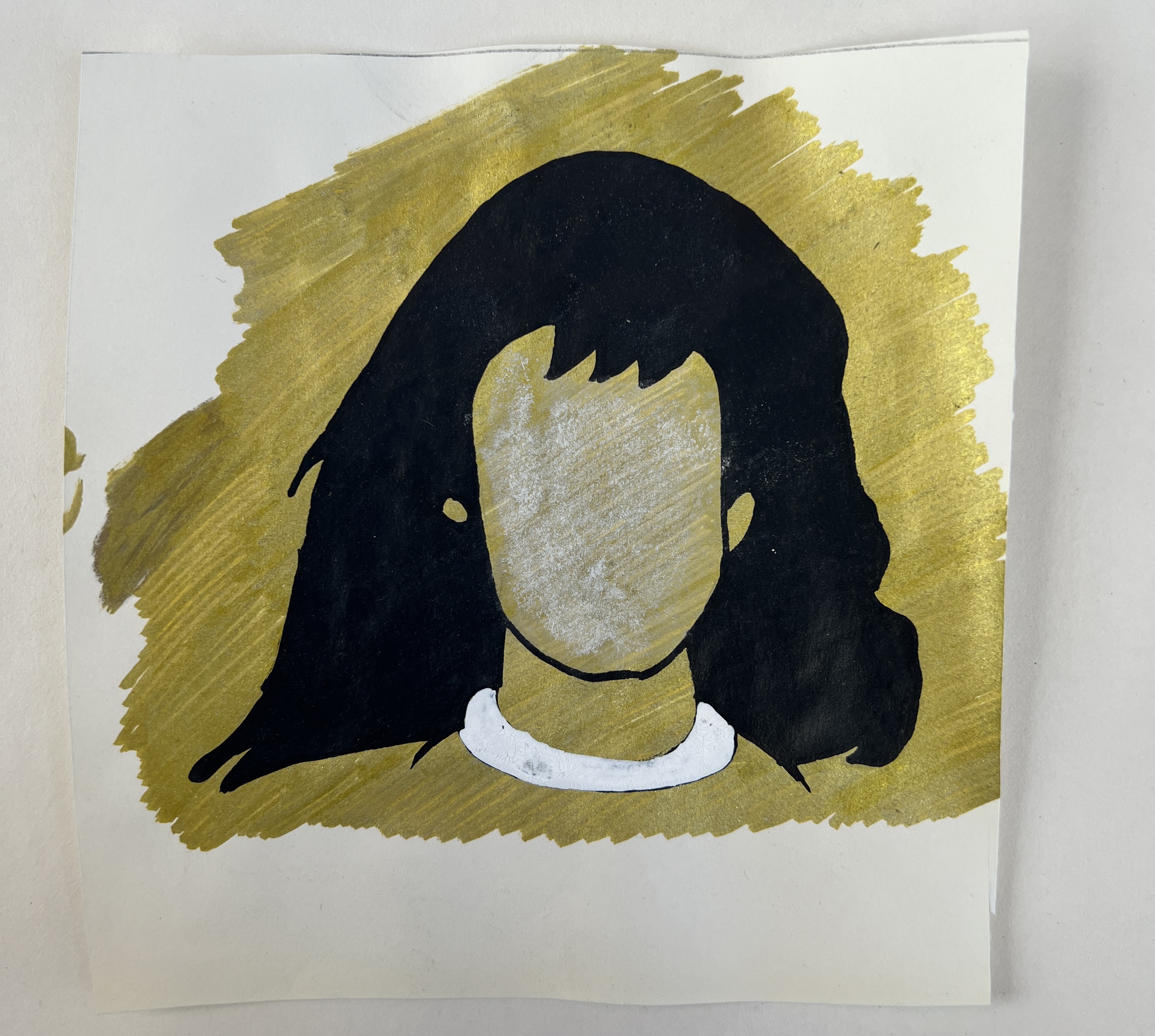
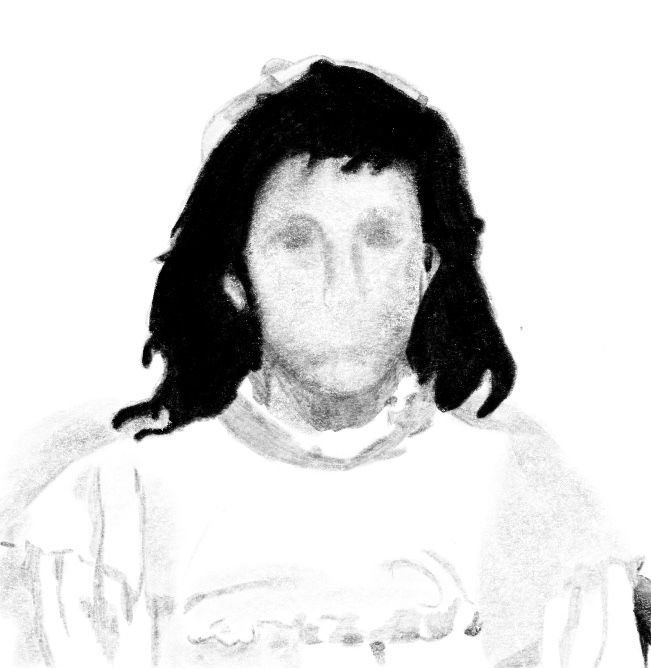
I am focusing on the identity aspect, and how the absence of details of the face can lead us to think of who this being could potentially be, and how a person making art is more authentic than an artificial intelligence (AI).

A piece of art created by a person can be copyrighted, thus meaning the legal right of the owner of intellectual property. This means that the original creators of products and anyone they give authorization to are the only ones with the exclusive right to reproduce the work.

However, AI 'artworks' could be deemed free of copyright because they are not created by a human author. As such, they could be freely used and reused by anyone.


--

An artist that has interested me in this topic is Charming Baker. Born in Hampshire in 1964, Baker spent much of his early life travelling around the world following his father, a Commando in the British Army. At 12, he and his family finally settled in Ripon, North Yorkshire. Baker left school at 16 and worked various manual jobs. In 1985, after returning to college, he was accepted onto a course at the prestigious Central Saint Martin’s, where he later returned as a lecturer. After graduating, Baker worked for many years as an international commercial artist and developed his personal work.

Although Baker has produced sculptural pieces in a wide and varied choice of materials and many large-scale and detailed drawings, he remains primarily a painter with an interest in narrative and an understanding of the tradition of painting. Known to purposefully damage his work by drilling, cutting and even shooting it, Baker intentionally questions the preciousness of art and the definition of its beauty, adding to the emotive charge of the work he produces. Indeed Edward Lucie-Smith has described Baker’s paintings as having, “something more, a kind of romantic melancholy that is very British. And sometimes the melancholy turns out to have sharp claws. The pictures make you sit up and examine your conscience.”


A certain piece made by Baker that I am drawn to is called Jane Doe, that being a woman who is a party to legal proceedings and whose true name is unknown or withheld, which is a painting of a woman sitting on a chair with one leg over the other, and both arms resting against the chair, all the while her head has been obscured to hide her identity. This aspect has been used in my work as I used obscuring pieces of a person's facial features to make their identity harder to recognise, if not at all.

(Jane Doe by Charming Baker)


So in response to this, I have created my own versions of the painting 'Girl With a Red Bow,' which currently resides in the museum of Nottingham Castle.

The girl painted is possibly a model used by the Nottingham School of Art, where Harold Knight studied in the mid-1890s. Painted with her arms folded - a common pose in portrait painting - her penetrating stare gives the painting intensity. Knight was a technically skilled painter who focussed largely on female subjects and interiors. Harold Knight was born in Nottingham. At Nottingham School of Art, he met his wife, the pioneering female artist Laura Knight, whose career frequently overshadowed his own.


(Girl With a Red Bow (1896) by Harold Knight(1874-1961))


Here are my first practice images for the topic, oldest (top) to latest (bottom):

I, however, did not like how the first two concepts worked out, so upon working on my final piece, I took some ideas from them (ie, the positioning and original concept) and reworked them to look as close to the original painting as possible.


From a person whose identity is stripped away because of the lack of identity in facial features, I have made them a new identity by putting together random people's facial features from other unknown people, thus being more obscure.

I have practised this digitally by redrawing the original image but taking away some of their facial features so they remain anonymous.


Below: known image of The Lady of the Dunes and my recreation, as well as the recreation of Girl With a Red Bow.


----

As well as some recreations of other unknown people:


-


However, carrying on with the unknown person's idea, I decided to splice features from others and put them together to create more unknown beings. As well as what I have done previously, recreate the splice by digitally drawing them.


Considering that I wanted my final piece to be a physical piece of art, such as on canvas, I decided to stay with the original first two concepts of Girl With a Red Bow because I thought of how I would paint out the splices smoothly with straight lines to make it look as if the features were actually cut and placed onto the canvas.

So I focused on giving the canvas a plain background so that it blends in with the image in the foreground without taking away too much attention from the main part. The main part is a simplistic version of the Girl With a Red Bow but with her face distorted/censored, inspired by Charming Baker's Jane Doe.


But if I was to recreate this painting, I would definitely put more time into thinking of where the details would go to make it stand out more.


Monday, 1 January 2024

Artists that have helped my creativeness in my project - essay

To convey feelings and emotions in art, an artist may use various colours, materials or positions of said materials to represent a certain theme or idea. For me, I used my interests in my art to make it look more unique and out of place, like the more uneasy side of things; such as the uncanny valley and liminal spaces.


The term 'Uncanny' in art is a concept that describes a strange and anxious feeling induced by familiar objects placed in unfamiliar or settling contexts, these contrasts stand out to the viewer making them think about it, sometimes even overthinking about it, thus making it more unsettling. The term 'Uncanny Valley' was coined by Masahiro Mori in 1970.

Artists drew upon the uncanny in art to create artworks that combined familiar elements in unexpected ways to provoke uncanny sensations. Today, the term ‘uncanny valley’ is also applied to artworks, animations, or video games that reproduce places and people so accurately that they generate a similar strange feeling.

Liminal space imagery often depicts this sense of "in-between", capturing transitional places unsettlingly devoid of people, common places that are empty or abandoned areas that appear eerie, forlorn, and often surreal. The aesthetic may convey eeriness, surrealness, or sadness, and trigger responses of both comfort and unease.

Liminal spaces and beings can also anemoia, which is the feeling of nostalgia that one has never experienced. This can make one think back at the memories that didn't happen and make the viewer feel sad about past times, whereas they would be sad about those unreal experiences.

Or kenopsia, which is the eerie atmosphere of a place that’s usually bustling with people but is now abandoned and quiet, like a school hallway in the evening, or an unlit office on a weekend, an emotional afterimage that makes it seem not just empty but hyper-empty, with a total population in the negative, who are so conspicuously absent they glow like neon signs.


An interesting artist that I have been following over time is Ron Mueck, who is an artist who works with fibreglass, acrylic fibre and fabric to create sculptures that can look like people. Such as his sculpture 'Ghost', created in 1998. It is a very large sculpture of a teenage girl wearing a dark blue swimming costume. The long-legged figure seems to lean awkwardly against the gallery wall, her arms hanging down by her sides with her hands and their curled fingers touching the wall behind her. She has brown hair tied in a loose ponytail at the back of her head, and her gaze is directed downwards and to her right.

The sculpture is completed in a highly detailed and realistic manner, such as small dots visible on the teen's face and light hairs on her arms, these features make the viewer think of how realistic the figure is, yet not let us think of who it looks like as it is a mashup of different facial features to create someone anonymous.

I have used this technique to create my versions of fake, unknown people as I put together the facial features of John and Jane Doe's, another subject I am interested in, as they are the faces of unknown beings.


(an uncanny look on the figure's face)


(image of the whole sculpture)


The uneasy posture of the figure in Ghost and her downward gaze, which seems to avoid eye contact with the viewer, are suggestive of the bodily discomfort often associated with adolescence, especially given the exposure of her form in the swimming costume. Furthermore, the heightened scale of the girl may be seen to echo how a teenager feels anxious at being the subject of others’ attention, yet it may refer to the fact that the girl seems to want to disappear from the gaze of those around her.


'Spooning Couple' (above) is another sculpture by Mueck, representing a man and woman lying down together. Both figures have a light skin tone and are semi-naked. The figures are represented with a high degree of realism apart from their scale, which is approximately half-life-size. They are displayed on a low plinth so that the viewer sees them from above. The couple lies in a spooning position: both figures lie on their right-hand side facing in the same direction, with the woman lying in a slight foetal position while the man lies behind her, his body curled next to hers. The man wears an off-white T-shirt and is naked from the waist down. He lies with his right arm bent under his head and his left arm bent up to his chest. His pale brown straight hair hangs limp around his face and his gaze is cast slightly downward. The woman is naked from the waist up and wears grey knickers. Both of her arms are drawn up close to her body with her right hand pressed lightly against her mouth. Her straight brown hair falls under her head with one strand falling loose. The woman's eyes are also open and she looks slightly down cast.


Spooning Couple was made in 2005 according to the same method Mueck consistently employs to create his sculptures. Like 'Ghost', the artist begins with drawings before creating small maquettes made from plaster or clay to refine his ideas. The maquettes are gradually scaled up to create a full-sized, detailed clay model of the work. From this clay model, Mueck makes a series of mould sections to cast the sculpture in fibreglass. The fibreglass sculpture is then painted and the hair is applied, with each strand inserted individually into the polyester resin. The last detail added to the sculptures is the eyes. 'Spooning Couple', like all of Mueck's sculptures, is rendered with hyper-realistic detail, noticeable from the texture of the skin to the careful placement of individual hairs. Before working as an artist Mueck was a puppet and prop maker for television and film, where he developed his precise techniques.

The position adopted by this couple would usually convey affection. However, there appears to be tension between the two figures. Originally the artist had considered draping the man's left arm around the woman's waist. Instead, he retracted the arm, leaving the man holding it close to his own body.

----


Anna Blom is an artist who has caught my eye and uses liminality in their work. A Swedish-born, London-based artist who has recently completed a Master's in Painting at the Royal College of Art. She holds a First Class Bachelor of Fine Art Painting from UAL Wimbledon College of Arts (2020). She has curated and participated in several group exhibitions and independent solo installations in the UK, such as 24 Cork Street and Copeland Gallery. Anna divides her practice between her London studio and Stockholm, where she works in an interdisciplinary manner combining painting, drawing, sound, words and found objects in arrangements of a continuous narrative in a diaristic archival methodology.

Her artwork is a narrative of her surroundings. It is an evaluation of the fragile details of the physical and psychological components of our everyday landscape, using a diaristic method she studies the isolated, overlooked and less-celebrated lapses of time. An act of watching and trying to understand co-existence.

The research is an archival process of collecting photographs, sketches, writing and white noise which is ultimately poured into a painting. The multiple layers on the canvas are built up with stains of thin washes using raw pigment and permitting situational debris to flow in. This creates textured, gritty, matt surfaces allowing the materials to explore each other, the colours indicating seasonality, and the debris enhancing an awareness of the place of production. The making itself becomes a memory of time and place, like a transition in an 'in-between', thus creating a liminal feeling.


An art piece from Blom that gives off this feeling is 'When Home Is Not a Home' and 'The Broken Blue Dress', both created with acrylic, raw pigments, and situational debris on canvas, in 2023.

Both of these paintings consist of the rough outline of a human, which gives it the liminal feeling as it looks like it is in the transition of disappearing, or becoming not what it was, as the titles suggest; the Home is not a Home anymore, and the Blue Dress is broken, thus not looking like how it should be. But this also gives it an uncanny look, as both of them have the human shape, the viewer does not know if they are a human or not, so we are put on edge as to what to think about it, the sudden scattered materials on the canvas and scattered dark spots of paint supports this, as well as the thought of sudden emotion.

It also shows that just because it has a familiar human shape, does not mean that we can trust it, even if it appears that it is leaving the canvas/image. For my pieces of art for the present and future, I can use this technique of using a human silhouette to give the viewer an idea of what they're looking at but giving the figure no distinct features so it still gives off an uneasy feeling.


Personally, I think that my art pieces reflect their inspiration mentioned here, because of the use of materials and types of shapes and textures made throughout, as well as colours used. In the portrait images, I have tried to convey the feeling of uncanniness as shown in the sculptures made by Mueck, by attempting to make them look too perfect, yet stick to my own ideas and inspiration with the idea of no identification. 


(When Home Is Not a Home)


(The Broken Blue Dress)

Wednesday, 13 December 2023

Research - Museum Construct

Different types of artists create as they collect objects for them to put into their own rendition of a collection in a museum.

Such as;

The Hunter is always on the hunt for something to add to their collection.

The Impulsive Buyer is the one that buys on instinct. The impulsive buyer walks into a gallery and immediately falls in love with a work. Without hesitation, the purchase is finalized. This collector likes to be surprised and must be immediately moved by a work.

The Adventurer overlaps with the impulsive buyer but deliberately seeks out unknown, new artists, galleries and fairs. They have an international scope and an open mind, always looking for fresh talent.

The Art Flipper is little liked by artists, gallery owners and other collectors. This collector is in it for the money, and with dollar signs in his eyes, he effortlessly parts with works that have increased in value. The flipper does not buy the work of emerging artists to support them, but rather to benefit from it himself.

And The Thinker can be easily spotted thinking in a gallery with the exhibition text in hand, while thoughtfully taking in all the works in detail. The thinker takes the time to talk to the artist, to understand their work and to exchange thoughts. Before deciding whether to buy, the thinker carefully considers whether the work fits into their collection.


A found object is a natural or man-made object, or fragment of an object, that is found (or sometimes bought) by an artist and kept because of some intrinsic interest the artist sees in it.

Found objects (sometimes referred to by the French term for found object ‘objet trouvé’) may be put on a shelf and treated as works of art in themselves, as well as providing inspiration for the artist. The sculptor Henry Moore for example collected bones and flints which he seems to have treated as natural sculptures as well as sources for his own work. Found objects may also be modified by the artist and presented as art, either more or less intact as in the Dada and surrealist artist Marcel Duchamp’s readymades, or as part of an assemblage.


An artist who works with found objects Damien Hirst, a British sculptor, painter, and designer, whose flair for self-publicity has helped him become probably the most famous and controversial British artist of his generation. While still a student at Goldsmiths College, London, he made a name for himself by organizing an exhibition of student work (‘Freeze’, 1988). From his youth, he had a fascination with death, and his most famous work is The Physical Impossibility of Death in the Mind of Someone Living (1991, priv. coll.)(below), consisting of a dead tiger shark balanced and weighted so that it floats in preserving fluid in a large tank made of glass and steel.


Tuesday, 5 December 2023

Research - Transgression And Taste

Transgressive art aims to outrage or violate basic morals and sensibilities. The term transgressive was first used in this sense by American filmmaker Nick Zedd and his Cinema of Transgression in 1985. From an academic perspective, many traces of transgression can be found in any art considered offensive because of its shock value; from the French Salon des Refusés artists to Dada and Surrealism. Philosophers Mikhail Bakhtin and Georges Bataille have published works on the nature of transgression. Transgressional works share some themes with art that deals with psychological dislocation and mental illness.

Transgressive art refers to art that attempts to push boundaries. In an effort at social critique, transgressive artists often use shocking themes and images. Robert Mapplethorpe is one such artist.

Another transgressive artist is Andres Serrano. Serrano worked with photographs and painting, and some of the themes he used were the Ku Klux Klan (like leads to his works related), gun violence, and religion. One of Serrano's most famous artistic series is a photographic series called Object of Desire. Here, Serrano explores themes such as life, death, and religion. One of the most famous photographs in this series is from the point of view of the photographer staring down the barrel of a gun.


Since the late 1990s, a new group of transgressive artists has emerged, such as the Canadian artist Rick Gibson who made a pair of earrings out of human fetuses (below) and ate a piece of human testicle.


During the 1984 exhibition of freeze-dried sculptures in London, an anatomy professor gave Gibson two dehydrated human fetuses. They were 10 weeks in development and had been dehydrated for 20 years. Gibson re-hydrated both fetuses, freeze-dried them and attached them as earrings to a female mannequin head. The sculpture was titled Human Earrings. They were exhibited at the Young Unknowns Gallery in south London in December 1987.


Another artist who uses transgression in their art is Stelarc (born Στέλιος Αρκαδίου Stelios Arcadiou in Limassol in 1946; legally changed his name in 1972), a Cyprus-born Australian performance artist raised in the Melbourne suburb of Sunshine, whose works focus heavily on extending the capabilities of the human body. As such, most of his pieces are centred on his concept that "the human body is obsolete". Until 2007 he held the position of principal research fellow in the Performance Arts Digital Research Unit at Nottingham Trent University in Nottingham, England. He is currently furthering his research at Curtin University in Western Australia.

Stelarc's idiosyncratic performances often involve robotics or other relatively modern technology integrated with his body. In 26 different performances, he has suspended himself in flesh hook suspension, often with one of his robotic inventions integrated. His last suspension performance was held in Melbourne in March 2012.

(Ear And Arm Suspension)


Module pieces - Frutiger Metro

(an example of Frutiger Metro) Frutiger Metro is a broad design aesthetic that encompasses the "Frutiger" vector-based graphic des...