Monday, 13 May 2024

Types Of Galleries, legal implications of being an artist (2024) and workshops with skill sharing

Art Dealers/ Gallerists

These represent artists and exhibit them in either group or solo shows. These higher-end venues are incredibly influential; you can choose who they represent. They have galleries in major commercial centres like London, Paris, New York and Berlin. They represent very established artists. They also participate in significant Art Fairs like Freeze or the Armoury Show. They sell art to top collectors and major public institutions like The Tate. They often take up to 50% commission. They only show artists who have major status. The good news is they show lots of great art for free.


Lisson Gallery

Marina Abramovic. Ai Weiwei. James Casebere. Tony Cragg. Angela de la Cruz. Richard Deacon.

- Gagosian
Francis Bacon. Georg Baselitz. Gregory Crewdson. Willem de Kooning. Giacometti.
- Barbara Gladstone
Miroslaw Balka. Matthew Barney. Keith Haring. Thomas Hirschhorn.
- White Cube
Miroslaw Balka. Georg Baselitz. Chuck Close. Tracey Emin. Gilbert & George. Antony Gormley.


Commercial Galleries

These sell work on behalf of artists and organise exhibitions, both solo and themed. Typically, artists meet all costs, including making, framing, and transporting, and they take a percentage of sales.


Transition Gallery - London

This is a commercial stepping stone for top dealers. It shows established artists on the way up, and more established galleries monitor them.

Tarpey Gallery - Castle Donington

Shows group and solo established artists. Less transitional due to regional location and place in the hierar

Cupola Gallery - Sheffield

Deals with fairly established artists. Closer to a shop situation but also curates thematic shows


Hire spaces

These are bookable spaces run by artist's studio groups and commercial organisations. Artists pay to hire the space or be included in their themed shows, and then the gallery deals with various aspects like staffing, preview, marketing, etc. Research location and status. You still have to go through a selection process.


Examples include

- Oxo Tower
- Brick Lane
- Surface Gallery


Artist-run galleries

Often within studio groups, these spaces are great for peer artist affirmation, and some are highly respected, but they are typically less used for selling work. They do carry credibility. Depending on their scale, they can have a whole team working with them on a paid basis or be solely staffed by volunteers. They are arguably the bedrock of artistic activity. These all started by artists with a DIY attitude determined to build their own art - world. You can start your own. Depending on scale, they receive ongoing public funding or work on a project-by-project basis. Some choose to avoid public financing so they can be free. They often are built around studio spaces.


- Bloc - Sheffield
- Backlit - Nottingham
- Airspace - Stoke
- Spike Island - Bristol
- Espacio - London


Regional Flagship Galleries

These show international artists (as opposed to artists who exhibit internationally). They are invited only by their curatorial staff, although they often employ regional artists to deliver art education programmes. Like public collections, they emphasise public engagement. In the UK, they are frequently partnered with organisations like the Tate, which means they have some access to their resources and collections.


- Nottingham Contemporary

- Baltic - Gateshead

- Firstsite - Colchester

- The Hepworth - Wakefield

- The Turner - Eastbourne


Main regional Galleries/Museums

These are either run as museum trusts and publicly funded or as part of the local authority. They tend to have their permanent collection on display, but they also show touring shows and initiate their own programme. Some are more reactive than others. Some have annual open exhibitions with a regional focus. They have a solid public emphasis from education to interpretation. Like regional flagship galleries, they employ artists in many roles and jobs.

- Nottingham Castle
- Derby Museums
- Birmingham City Art Galleries
- Sheffield Museums
- Liverpool Museums


Arts Centres

These are typically multi-purpose, often having cinema, exhibition, and performance spaces, and can even include dance studios. They have more flexibility in what they show and present due to not having a permanent collection to manage.

University Galleries

These show curated public exhibitions and, in some cases, many other types of creative activities which sometimes (but not always) connect to the research interests of the academic community. They provide a cultural focus for the institution and its community. They vary in size and status considerably.


- UH Arts

- Bonington Gallery

- Lakeside

- Kettles Yard


Pubs, cafes, libraries, etcetera

These can be suitable starter spaces. Just make sure you agree in advance on things like commission, who pays for what, and what happens if work gets damaged or stolen. Some are curated, i.e., organised by a person.


Open house/studio

There are many organised events, like Sherwood Arts Week or Nottinghamshire Open Studios, where you can open up your workspace to visitors. If you don't mind talking to strangers in your own home or space, these are good for reaching out to a local audience.


DIY Venues and pop-up shows

There are many empty shops and spaces that artists can take over for an exhibition. They need to have their own insurance and be sure they will not be charged for business rates. Art Quest, an artists' advisory organisation, has some advice below. This DIY culture has a strong tradition and is an excellent way of kick-starting your showing career.


Legal implications

I know that an artist needs public liability insurance to put their art on exhibition, which covers the policyholder against any claims made by third parties (e.g., members of the public). A member of the public might make a claim if they are injured during an exhibition, for example. Artists' insurance also covers loss of property like tools, supplies, and artwork from risks like fire, natural disasters, lightning strikes or theft (business personal property). Loss of a studio building you own. Loss of tools, display equipment, or artwork away from your studio, such as at an art show, doing an installation, or in transit.

I also understand that you don't work and sell items as a hobby business. You won't pay income tax on profits less than £12,570 (your personal allowance). Below is an example of how much you might pay for the current tax year: Income from employment: £40,000. Profits from self-employment: £14,000.

  - cerf+


In the future, I can see myself participating in an exhibition at a Commercial Gallery. I like to work with set themes more so that I know what inspires me, and I base my art around those themes and motivations.


Tuesday, 7 May 2024

Arts Developement agencies

Arts development organisations have an intermediary role between artists and society. They typically work to use and apply the creative arts to help improve opportunities and quality of life in a given location. Some have a central space from which they set up projects, while others are more organic.

They periodically apply for core funding to pay specific staff and run a programme that engages and enables people. Unlike many galleries, they emphasise empowering people rather than profiling artists.


Artcore - Derby

"It is an international centre for contemporary art and creativity based in Derby, UK, and is home to Artcore Gallery, studios and workspaces, and a shop and cafe. A vibrant hub for commissioning, production, presentation and debate, we offer opportunities for diverse audiences to engage directly with creative practices through participation and discussion. At Artcore Gallery, contemporary art and creativity are central to developing people and places. We have an extensive exhibition and residency programme that helps support early, mid-career, and established artists in creating work that deals with pressing social, political, and environmental issues. Each year, we welcome over 4000 people from all sections of the diverse communities of Derby to experience inspiring, innovative and high-quality exhibitions and events. Over 25 years, we have developed links all over the world. This cements a global creative community and helps us support aspiring artists in this contemporary world."

- Artcore Gallery


Artcore Gallery is newly located in Artcore's second building in Derby's City Centre, which opened to the public in August 2019. This is a base of operations for our contemporary art activities. The gallery is a versatile space, and our busy exhibition programme of ten shows each year supports the development of emerging artists from Derby and the East Midlands and features the work of more established UK and International artists.


City Arts - Nottingham, Mission statement

The need for creativity is lifelong and universal. Being creative makes people happier, healthier, empowered and more equal. It brings people together, and it changes lives. Since 1977, we have helped communities and artists create and explore art of all kinds - from music to writing, drawing to dance. We aim to allow everyone to be creative, regardless of who they are or where they're from. City Arts is a charity. We rely on donations, public funding and income from our small venue in Hockley, where we host music, comedy, film and poetry events as well as hands-on workshops and exhibitions. All our income goes into running our programme of arts activities - some of it for the general public, some for particular groups like care home residents or vulnerable young people.

Our Values

City Arts tries to enact the values implied by a rights-based approach to cultural participation in all its work.

Specifically, we expect our work to be:

  • Creative - because we make new art from today's ideas and interests
  • Respectful - because everyone has the same right to participate in culture.
  • Empowering - making art is a way to learn, grow, and strengthen.
  • Ambitious - because everyone wants to achieve the best they can.
  • Trustworthy - because our work depends on mutual confidence
  • Enjoyable - because if art doesn't bring pleasure, it's no use to anyone

These values - CREATE - shape every aspect of our work. They are the foundation against which we assess our performance. They are the values by which we hope others will judge our work.


The team at City Arts


Suzannah Bedford - DIRECTOR

Responsible for the overall running and creative direction of City Arts, Suzannah has over 20 years of experience working in the arts. Her expertise spans all art forms. Suzannah believes people are at the heart of shaping and making new possibilities in the arts. She is passionate about broadening access to the highest quality creative experiences, ensuring that the arts celebrate the diversity we enjoy today.


Alison Denholm - CREATIVE DEVELOPMENT MANAGER

Responsible for nurturing new ideas and projects, she focuses on outdoor arts: carnival, street puppetry, festivals, and guests. Her background is in visual arts; she has worked in Nottingham for 20 years. She was on the leadership team for the World Event Young Artist Festival, likes a parade, and has made a set of giant flamingos.


Kate Duncan - PROGRAMME DIRECTOR - WELLBEING

Kate is responsible for arts and wellbeing programmes, manages strategic partnerships, and has extensive experience researching art and wellbeing.

Passionate about creative ageing, Kate produced Armchair Gallery, an app for older people in care. Kate's background is in teaching and arts management.

She's worked in some exciting places.


Joe Pick - MARKETING & AUDIENCE DEVELOPMENT

I am responsible for City Arts' design, PR, and online presence. I also research and monitor audiences. Creating art makes Joe's life more enjoyable.

He'd like other people to experience this. He is particularly interested in improving access through design. He made this website. He draws animals.


Alma Solarte-Tobóa - CREATIVE PRODUCER

Supporting young people's participation in City Arts projects. Alma has dedicated most of her career to working with young people. At City Arts, she founded the Express Yourself project, the Young Producers group, and, most recently, ART CLUB. She has also flown a plane.


Joel Stickley - DEPUTY DIRECTOR

Joel is responsible for the day-to-day running of City Arts and managing strategic relationships. His background is in literature and arts management, and his employers include Arts Council England, Nottinghamshire Libraries, and Writing East Midlands. He was a Poet Laureate for Lincolnshire and once won an award at the Cannes Film Festival.


Air Arts - Derby Hospital


Air Arts is the arts charity for Derby Teaching Hospitals. It promotes health and well-being through the arts and arts participation.

Air Arts was established in 2007 with the aim of creating a calm and welcoming environment, providing support and reassurance for patients, staff, and visitors, enhancing the environment, and providing moments of reflection and distraction.

They do this by bringing art, dance, drama, poetry, storytelling, crafts, and music to the corridors, waiting areas, and wards at the Royal Derby and London Road Community Hospitals. They work closely with staff and patients to provide personalised creative activities, support relationships, and improve patient and staff experience.


Exhibitions

Arts presents two exhibitions annually at 50 locations across both hospital sites and hosts temporary guest exhibitions, making us one of the largest hospital art exhibitors in the country.


Commissions

They have several large-scale public art commissions in our collection, which enhance the hospital environment and create a calm and welcoming environment for the 9,000 staff and 2 million visitors at our sites annually.


Gardens

Air arts have developed many creative outdoor spaces in and around the hospitals.

These gardens address many of the needs of a busy hospital environment, contemplation, refreshment, and remembrance.


Engagement

A significant part of the programme is engaging directly with ward patients.

They have four models of an artistic intervention designed with patients and staff to target and reduce boredom, depression, and feelings of anxiety and stress.


Performance

Every week, musicians visit the hospital to perform in the public spaces. Live music transforms the atmosphere and provides a much-needed distraction from worries and anxiety.


Enhancements

Every department and ward in a hospital is different, with different patient needs and space requirements, working closely with staff and patients to positively enhance their areas in accordance with their specific requirements.

Monday, 29 April 2024

Tom Hackett

Born in Cambridge, Tom Hackett is a sculptor who studied fine art at Middlesex and Nottingham Trent Universities. He is a small artist based in Nottingham who focuses on sculpture and practical art pieces, such as acting out something or wearing something. He profits from these pieces of art and exhibitions. In addition to making art, he also lectures and teaches at Nottingham College to support himself and his family. As someone who has been in his lectures, I find the information that he gives out to be very helpful because it gives us an insight into what life as a small artist can be like; you can make some profit from it, but not enough to go full time. 

Hackett has an established reputation for his multiple sculptural installations, exhibitions, and performative interventions at contemporary art galleries and in the wider public. He makes sculptures across a wide range of media and concepts.

"My work is about several inter-relating strands. None stand alone. Central to much of what I have done is the desire to make connections and collaborations with people, places and situations. I often try to unpick the ‘sense-making’ paradox, which can both limit and drive humanity forward. I am interested in the place of written and spoken language within this quagmire. I regularly use interruption as a tool to question, dissect and reveal the everyday and ordinary, which frequently gets lost in the haze. Humour and absurdity play a part in this, with regular use of dislocated objects, forms and performative actions. For me, art is an affirmative interjection which can bring something of value to the table. It sits somewhere in between an offering, a question and a possibility. It works best for me when it blends the palpable with the intangible and travels beyond the simple distillation of a feeling, an action or a set of ideas. For me, that’s where the alchemy lives, and it is by this force any artwork ultimately stands or falls."

- Tom Hackett.


My favourite piece of art by Hackett is a sculpture set called 'another green world,' I really like this piece because of how realistic it is, yet it isn't. Because the birds aren't real, the branch placements make them seem authentic and real, just like a real tree. I can take inspiration from this piece to incorporate elements into mine with how natural it looks, and I want my art to look natural too.

It is an installation of sculptural birds, "I aimed to create a sense of dynamic visual movement punctuating the sightline and interrupting the institutional nature of the space. This is intended to generate a playful shift in the day-to-day experience of those passing through the area and foster a sense of calm contemplation. Thematically, it brings notions of nature and the wider environment to the fore. The wall-based birdhouse plays intermittent bursts of birdsong. The combined visual effect is to bring the outside in. Overall, this artwork can be seen as a gentle nudge towards re-connecting the disconnect between us as humans and the natural world upon which we depend. Signalling a simple truth, we and the birds are very much part of the same world. Looking forward, the project hopes to have a wider creative legacy, as a catalyst and departure point for future student activity.

As a project, it is underpinned by an artistic commitment to having a low environmental footprint by using low-impact and re-used materials, which, if needed, can be recycled or disposed of without polluting the environment. The white earthenware clay is locally sourced in the Midlands (where many former clay pits have become wildlife sites). Two-thirds of the square aluminium bar used to create the curved linear forms are re-purposed from a prior installation exhibited at The Brewhouse in Burton. The aluminium suspension poles are recyclable (the global rate for aluminium recycling stands at 76%). With the world in climate and ecological crisis it is crucial that artists and designers work towards minimizing our impact and embrace sustainability through process, material choices and product longevity. As transmitters of meaning we can all raise the environmental agenda through art, communication and demonstrating good practice."


Tuesday, 26 March 2024

Rachel Carter

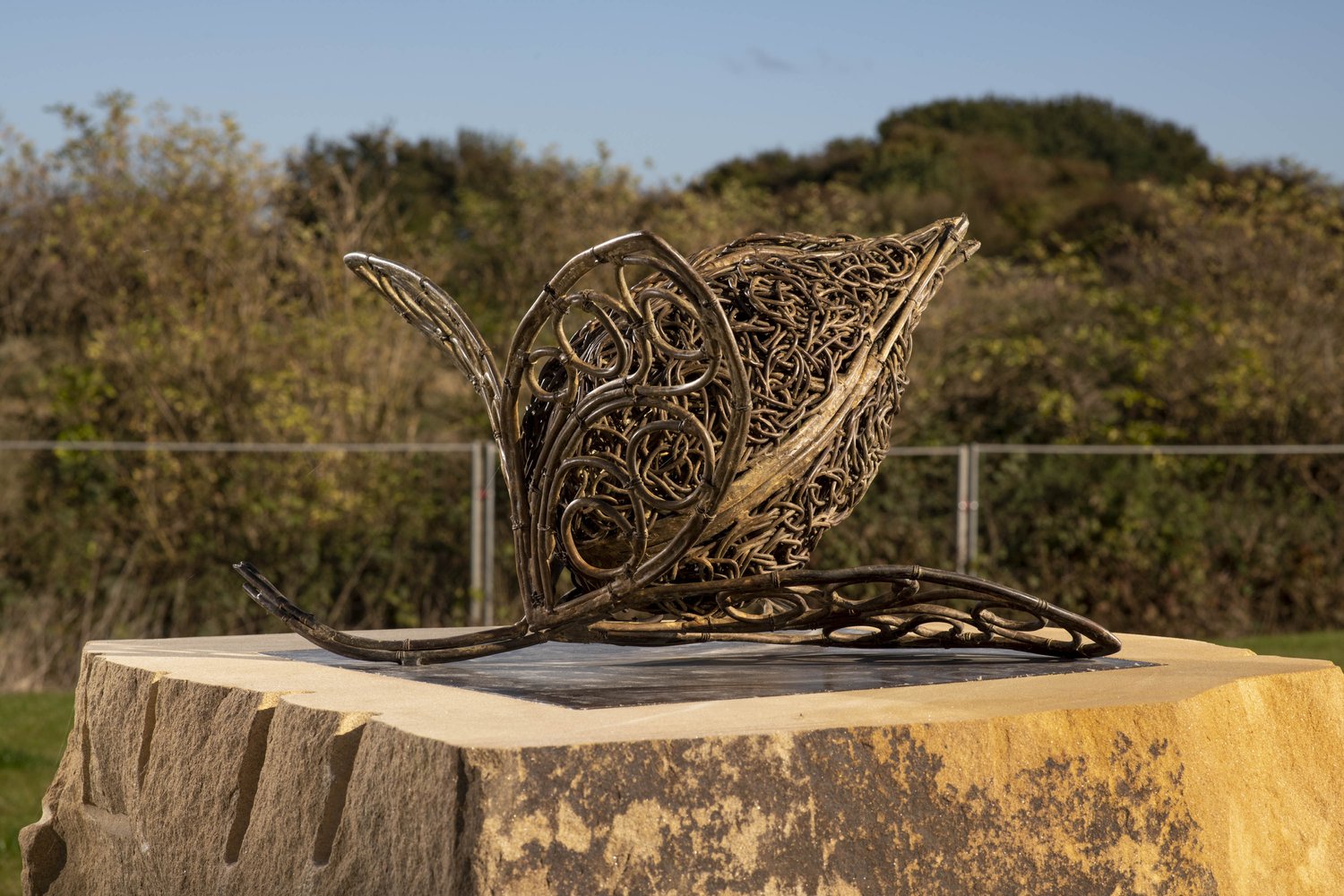
Sculptor Rachel Carter works from The Garden Studio on the Derbyshire/Nottinghamshire border. She uses the lost wax technique to create bronze works on a large scale for the garden and smaller, intimate sculptures for the home. All of this work inspired Carter to eventually create Standing In This Place.

“Throughout my professional practice, since graduating with a BA Hons in Applied Arts, I have found myself driven by process and material in sculpture. For the 400th anniversary of the Mayflower sailing in 2020, I was commissioned to create a new series of work for the Pilgrim Roots districts. The ‘Pilgrim Woman’ sculptures combined my hand-woven work alongside community weaving, which was cast in bronze, a plus life-size pilgrim stands in the Danum Gallery, Doncaster, a smaller version on the banks of the River Trent in Gainsborough, and the third Pilgrim Sculpture is in Boston, Lincolnshire.”

“Many of my commissions are underpinned by my love of history and ancestry, and I feel honoured to be able to represent our shared and complex histories within sculpture. Looking at my own ancestry often inspires new work as I add to the long legacy of weavers, knotters and makers stretching back over 350 years of the Midlands industrial past.”


Standing In This Place is an arts and heritage project co-created by sculptor Rachel Carter & the Legacy Makers, in response to the work of the Legacy Makers group Est. 2014 by Bright Ideas Nottingham and the collaborative community-academic Global Cotton Connections project. It looks to highlight the contributions and connections between white mill workers and black enslaved women uprooted to the Americas, showing how their stories and histories are connected by cotton, sorrow, strength and resilience.

Through collaborating with the black-led community group Legacy Makers, we have been questioning who is and who should be remembered. While also being aware that less than 5% of statues in the UK portray non-royal women.

This ambitious project, exhibitions and new sculpture will give representation to the under-represented and give voice and recognition to the contributions of thousands of unnamed women connected through cotton and help to ‘challenge the 5%’.


"The title 'Standing In This Place' originated in my quest to find female ancestors. My family is deeply rooted in the Midlands, and I found my working-class ancestors mainly working in the textile and coal industries.

When trying to find places and connections to my female ancestors, I often discover that no trace remains. When looking at illiterate female ancestors, it’s hard to find any information about who they were other than that they were born, married, had children, and died.

Newspapers in the National Archives have been very useful in helping me understand the lives of some of these women. For example, I discovered one such story about a female lacemaker: aged 19, she was arrested for drunk and disorderly conduct at Weekday Cross, Nottingham. When I visit the Lace Market area of Nottingham, particularly the Weekday Cross, I can stand where my female ancestors once stood.

The idea behind the sculpture's title was to be able to stand where my ancestors once stood. When I began working with the black-led community group Legacy Makers, I discovered the difficulties they face when tracing ancestors of African origin. The ability to discover information about their ancestors, their roots, and the places they once stood becomes much more difficult.

When thinking about the sculpture that we are creating and its intended placement in the Broad Marsh new public park, it feels like a very fitting location as census data for the 18th & 19th centuries show many female textile workers living in the Broad Marsh and Narrow Marsh areas, you can clearly see many workers, immigrants and paupers all living side-by-side in close conditions.

The two women featured in the sculpture are our connection to our ancestors. We tread in their footsteps, and we stand in this place."

- Carter.


(Minature Shell Forms)

This miniature collection features delicate bronze sculptures that fit into the palm of your hand. They are displayed in a glass bell jar inspired by natural history collections of sea creatures that create a protective home around them.

Each miniature was hand carved directly in wax and featured intricate macramework using fine waxed cotton thread worked directly onto the sculpture's surface. Transformed into bronze using the traditional lost wax technique, they have a green patina and are polished in beeswax.


(Bronze Seeds)

In 2021, Rachel was commissioned to create a series of way markers for Redrow Homes' new housing development on the outskirts of Derby City. Durose Country Park’s circular nature walk will include four bronze seeds depicting common seeds from the countryside. The Maple, Elm, Horse Chestnut, and Sycamore seeds are woven first in wax and then cast in bronze using the traditional direct lost wax method.

Thursday, 21 March 2024

Mik Godley

As someone who prefers to work with digital art rather than traditional, I can draw inspiration from Mik Godley, an artist who uses an iPad and mobile phone, rather than a traditional art school lecturer based in Nottingham. He is a painter who uses both traditional painting techniques and digital technology. This exhibition is a major presentation of Mik's ongoing body of work, 'Considering Silesia,' which began in 2003 and has been the focus of his work for almost twenty years. Mik’s work has been exhibited from San Francisco and Baltimore to Zagreb, featured in several publications, and received awards and critical acclaim.


"Considering Silesia brings together the largest and most comprehensive selection to date of paintings, drawings and prints by Nottingham-based artist Mik Godley. But rather than an unfocused retrospective, this exhibition concentrates specifically on works made as an oblique response to his own family’s connection to – and wartime displacement from – the formerly German, now mostly Polish region of Silesia, as mediated by the internet over an eighteen-year period. By Godley’s own account in the various lucid wall texts accompanying the works, it’s a project that began with the acquisition of his first computer, almost as a curious side-project, which rapidly expanded in scope, taking over much of the artist’s time and energy."


Born to an English father and German mother fewer than fifteen years after
WW2, Mik grew up in the Yorkshire coalfields. Once he started school, Mik stopped speaking German and became English. It wasn't until he got his first computer in 2003 that Mik started researching the German side of his cultural identity. The simple idea of "let's see where mum came from" prompted Mik to start researching online and documenting the things that he discovered. The once German but now Polish region of Silesia has a complex political and social history, which Mik has explored in his work for almost two decades.

This vast and wide-ranging body of work not only marks Godley's discovery and deepening understanding of his family history but also records significant changes in the increasingly detailed and immersive experiences of distant places and people that digital technology can offer. Despite having never visited his mother's homeland, Mik has documented the landscape, architecture and people of the region through images, video footage and maps found online.


As digital technologies developed to the point that large amounts of data could be easily stored and shared, and touchscreen devices became more sophisticated, Mik began moving away from traditional drawing and painting to making work on iPads and smartphones. Since around 2014, most of Mik's work has been digitally made.


"Although my drawings usually take several days to produce, iPads and smartphones can be incredibly quick - you don't have to wait for stuff to dry - and allow immediate online dissemination. You can post online or send files to be printed and exhibited anywhere in the world. The iPad and several of the apps are really easy to use; though some of the apps can be complex if needed, they can also be used very simply, which suits me. Then there's the portability. The iPad is effectively a portable studio and can do pretty much everything l need. With the Pencil stylus, it now offers professional-level precision - it's no longer finger painting."


- Godley.


(Considering Silesia, installation view, Attenborough Arts Centre, 2021.)


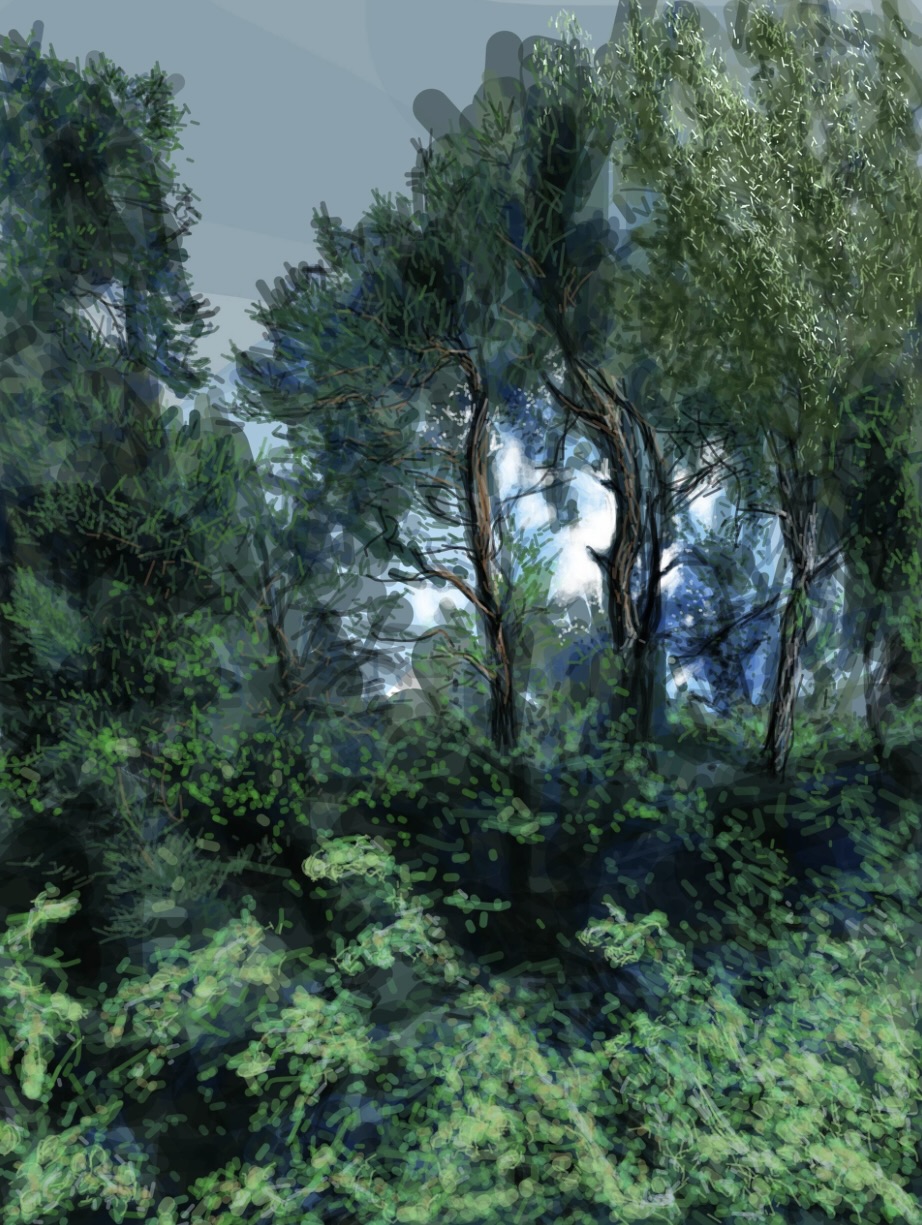
I prefer digital art to traditional art because creating digital art saves time. If you make a mistake on a digital drawing or painting, you can simply press the undo button to start over without making a mess trying to erase the mistake. In a digital creation, you can erase without a trace, change colours easily, and position and resize objects in seconds. Godley shows this with his work 'Lofthouse Colliery Nature Park Looking East.' From a distance, the image looks realistic with its shading and other tones on the underside of the cloud, and different colourations for the leaves on 'Near Nowowiejska 7, Wałbrzych, via Google Street View', but upon closer inspection, it is revealed that the image has neat, unkempt links and squiggles to create its textures and dimensions.

I take inspiration from Godley as viewers can see that the piece of art may look somewhat unkempt with uneven details, but from afar, it looks nice and somewhat realistic, and I have tried to make it work in my work, too.

(Above: Lofthouse Colliery Nature Park Looking East)


(Below: Near Nowowiejska 7, Wałbrzych, via Google Street View)


Module pieces - Frutiger Metro

(an example of Frutiger Metro) Frutiger Metro is a broad design aesthetic that encompasses the "Frutiger" vector-based graphic des...